Research previewPreliminary · work in progress
A blinded language-model screen for repeats in human disordered proteins
Repeated motifs in intrinsically disordered regions are hard to find by alignment: the copies are short, differ from one another, and are spread out along the sequence. We gave a language model anonymized human protein sequences, with names and annotations removed, and asked it to describe any recurring pattern as a consensus together with the copies it was based on. A script then located each reported copy in the sequence and discarded any that could not be found. Set against UniProt modification sites and ELM motif annotations, the screen places known sites and motifs at a fixed position in the repeat unit, finds the same motifs in arrays that have not been curated, and turns up positional modification patterns with no description.
Highlights
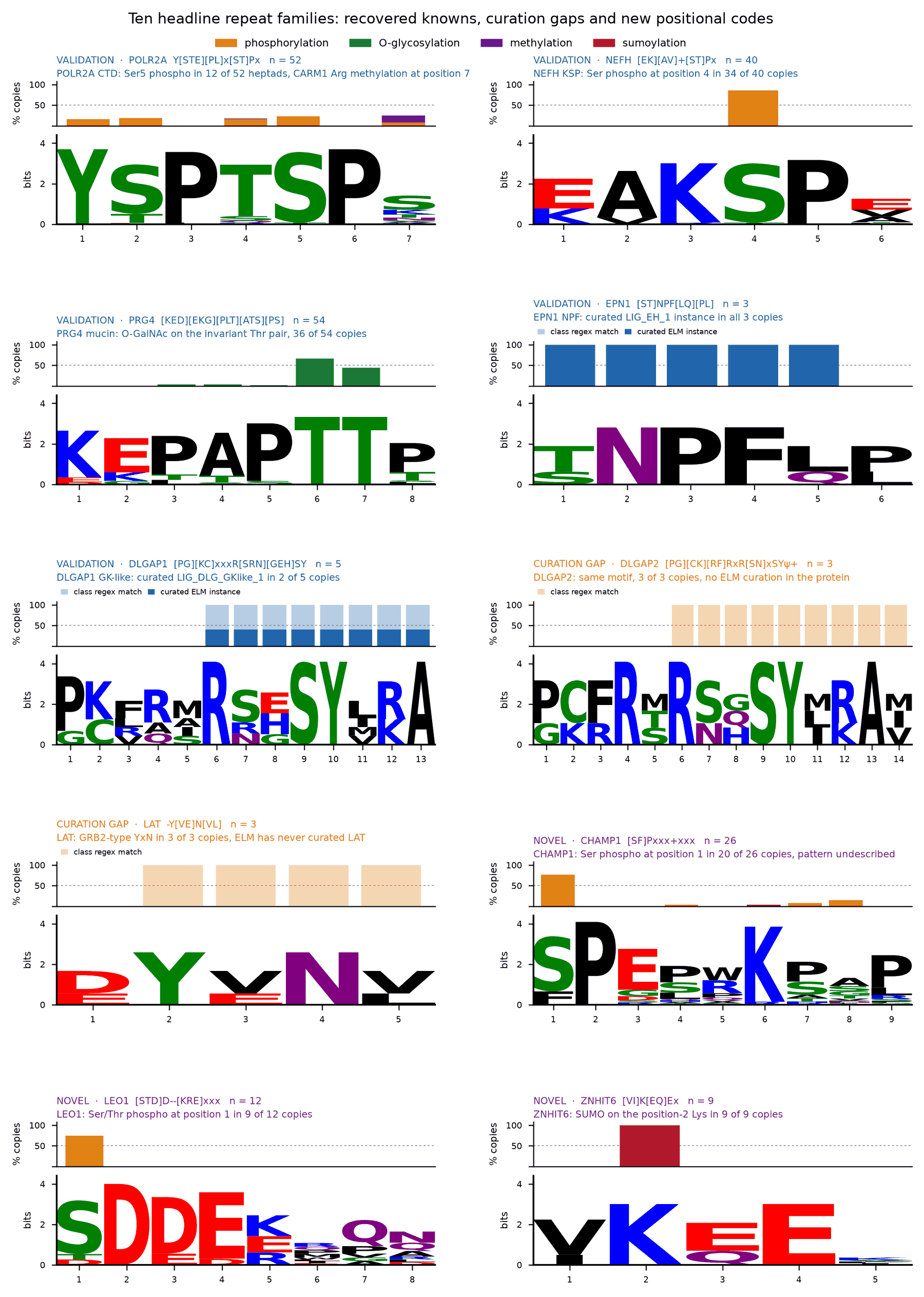
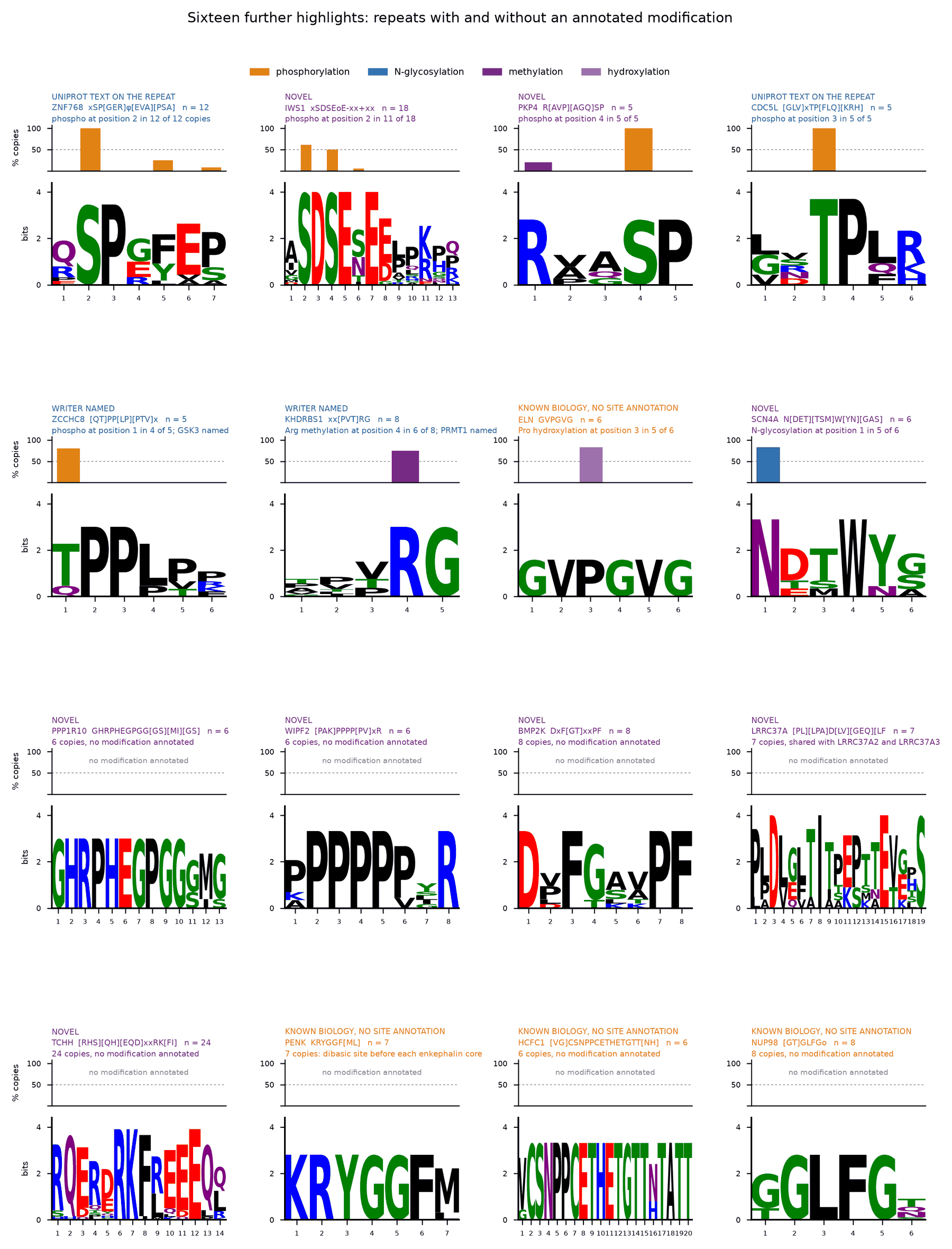
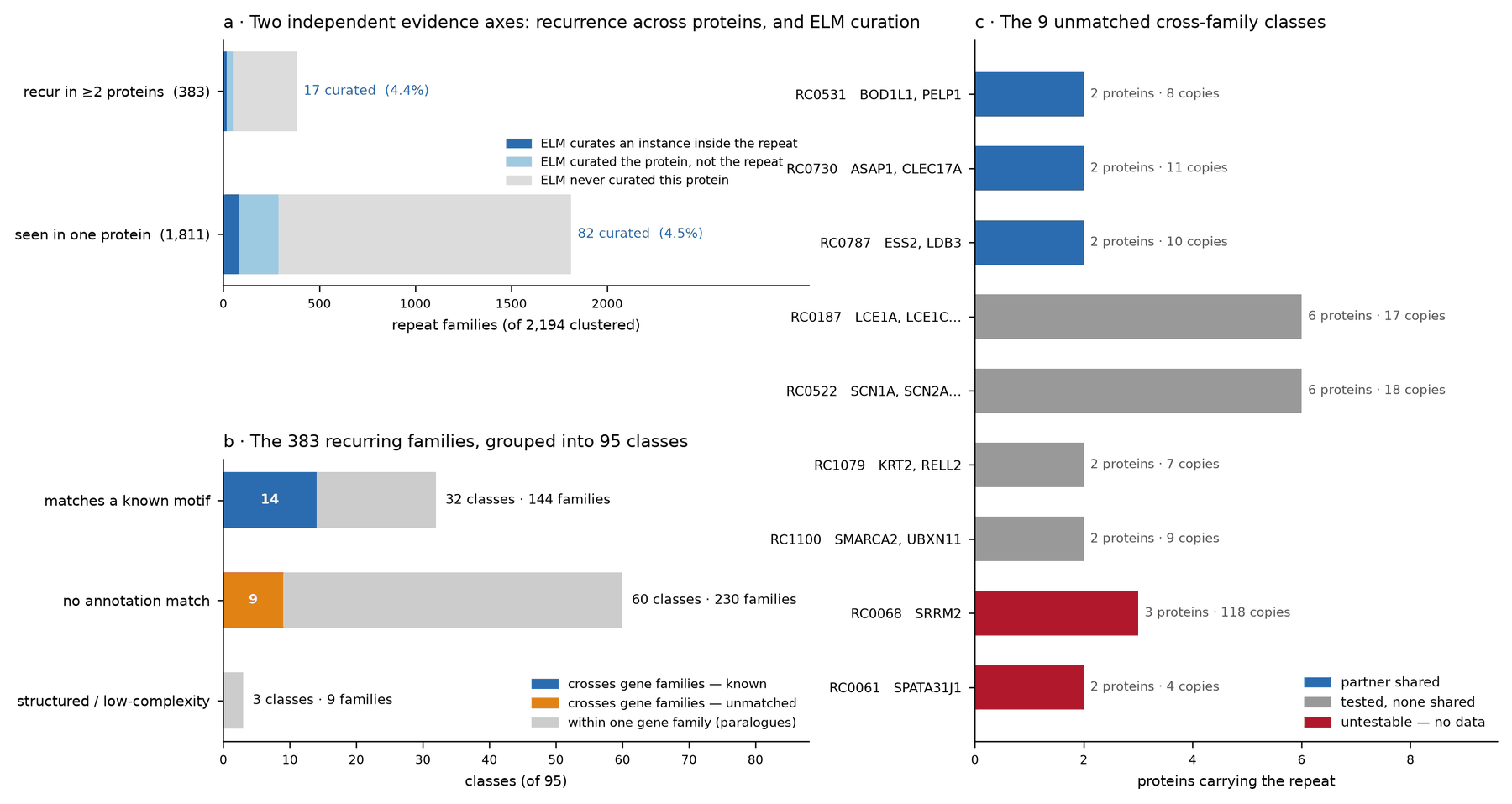
Highlights are grouped by novelty: repeated patterns with no description, new occurrences of known motifs, and known repeats the screen recovers blind. Within each group, families with a UniProt modification at a fixed unit position lead, because a modification at the same position in most copies is independent support that the unit is real. Each family gets an evidence badge for the modification it is about, a literature badge from a PubMed abstract sweep, and one of three ELM calls: curated in the array, curated elsewhere in the protein, or a protein ELM has never curated (87% of families, where ELM's silence says nothing). Repeat architectures follow as a separate set of examples. Select any family to see its AlphaFold model, its copies against UniProt annotations, and the modified unit position marked in each copy.
The screen at a glance
Method
Scripts handle cohort selection, blinding and coordinate lookup and contain no motif-finding logic. The model sees only an anonymous sequence. Throughout, a repeat family is one repeat array inside one protein: counts of families are not counts of distinct motifs, and every count on this page says whether it counts proteins, families or copies.
Cohort
Human proteins with ≥100 aa of disorder, from UniProt / MobiDB-lite regions or a TOP-IDP propensity window.
Blinding
Names and annotations are removed and sequences get shuffled anonymous IDs. The key is kept separately.
Two-pass reading
One pass for long structural repeats, then an independent pass over disordered stretches for short anchored motifs (≥5 aa, usually ≥3 copies).
Locating copies
The model quotes each copy it reports. A script finds each quote in the sequence and records its coordinates; quotes that aren't in the sequence are dropped. Copies need not match each other.
Unblinding
Identities are attached only afterwards, then results are compared with UniProt features, ELM and AlphaFold models.
Consensus notation. One symbol per residue position; unit positions in the highlights count these symbols from 1.
W fixed residue[ST] one of thesex any residue(x){4,13} variable loop
φ hydrophobic (AVILMFWY)ψ large aliphatic (VILM)Ω aromatic (FWY)
+ basic (KR)- acidic (DE)o polar (STNQ)
Catalog
Every protein with at least one repeat family. Search by gene, protein name or consensus; click a row to open it in the explorer.
| Gene | Repeat families (consensus, copies) | ||
|---|---|---|---|
| Loading catalog… | |||
Citation
This is a preview of work in progress; the screen is still running and the numbers will change. Please get in touch before citing.
@misc{mcwhite_repeats_preview,
  title  = {A blinded language-model screen for repeats in human disordered proteins},
  author = {{McWhite Lab}},
  year   = {2026},
  note   = {Research preview},
  url    = {https://clairemcwhite.github.io/repeats/highlights.html}
}